
|
|
 About Spring, Buses and Agriculture
And why, actually, "LETIT", you ask?
Perhaps it's hard for me to explain it myself.
In 1988 I worked as a scientist in an agricultural laboratory. The laboratory was located outside the city, and I had to make a 2-hour journey on suburban buses to get there. That's when, as far as I remember, during one of those trips, this remarkable name for the ensemble came to mind. At first I thought of calling it "VEZUT" (They're taking), but after thinking, I decided that there was something forced and hopeless in that name. So I settled on "LETIT" (It flies).
It was spring. The height of perestroika. My twins had just turned one. I was reading Hesse, CortГЎzar and works on the art of the Impressionists. Revolution. Vodka rationing, queues at four in the morning for kefir. Rock clubs and rock bands all over the country. Universal hysteria of change. Who could stay away from this? And I, abandoning my work, sat down to "Iran-Iraq Conflict".
This title had been circling in my head for a long time, back from the days of "Expedition" - when we gathered once a year with the Kurgan guys Vlad Voitovich and Vadim Khodosevich, considering it our duty to record a tape album. (One of the albums was recorded on the premises of the "Expedition for the Protection of Grain Products" - hence the name of the group). A phrase heard once on the short waves of Deutsche Welle from Cologne, that there was no more senseless war in the twentieth century than the Iran-Iraq Conflict, determined the concept of the album.
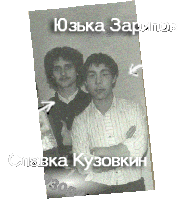
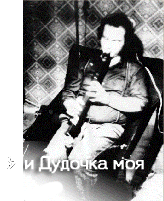
All the songs here are built on oppositions - Us and Them, Those and These, the Paris Commune and the Iran-Iraq Conflict, Moth and Fire, Words and what stands behind them, etc. I probably didn't expect myself that the album would take such a coherent form. A revelation for me was that I could play things like "Dog Flute". Phonetic experiments, developed from the avant-garde poems of Slavka Kuzovkin and Yuzka Zaripov, seemed like a new and unexplored form of searching for meaning. In general, I was so stunned by what came out that in a rush I sent the tape with the album to some Petersburg magazine for some major competition. Naturally, it led to nothing.
Time of Nonsense
In 1988 I assembled a drum machine. I must say, I was constantly plagued by problems with percussion. I never knew how to play the drums myself, and recording them properly under the conditions at the time was practically impossible. The drum machine solved all problems at once.
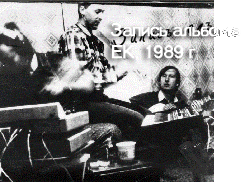
But the drum machine didn't last long. By the end of 1988, only the analog sound generators remained. I attached contacts from some relay to a piece of plywood, creating something like a keyboard that could be pounded with fingers to produce some semblance of percussion accompaniment. But these problems couldn't stop me. After enduring no more than a week after finishing the "Conflict", I started on the next album. The title had been thought up long ago - "E.K." There was enough material.
But after recording two or three songs, I had to put aside my activities because I had a falling out with my scientific superiors and started quitting, finding a new job, and generally doing all sorts of nonsense. All this settled down only by the middle of 1989.
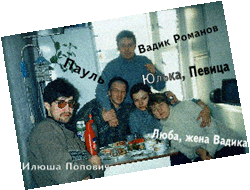
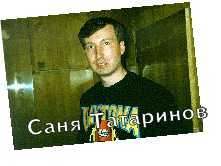
The rest of the album was recorded in various places in Chelyabinsk, with the participation of Sanya Tatarinov and Vadik Romanov, whose presence was discovered at my new place of work - the computing center of Gosagroprom. Whether because the recording was spread out over almost two years, or because of lack of cohesion, the album turned out somewhat crumpled and more reminiscent of amateurism, or the early sound experiments of the "Expedition" group. But still, this album possessed some integrity, and I was satisfied with the result.
Moreover, some things, as it seemed to me, became interesting discoveries. One of them is a fairy tale, told by Lisa Romanova, Vadik's daughter, about the Man-Eater, the Fox Perry and other evil spirits, arranged by Vadik Romanov. Or, for example, the stream of consciousness in "A Rag of Memories", poured out by me on paper either completely drunk or with a temperature of 40. Or snippets of nostalgia in the Nocturne. By the way, in the nocturne I tried to record the voices of my twins in the background, who were about a year and a half old by that time. But due to numerous overdubs, they are almost inaudible.
In addition to traditional guitars and my once-purchased "FAEMI-1M" keyboard, a "balalaika" was used in the recording, borrowed from a Chinese acquaintance Leva Djan, which had some rhythmic capabilities.
Winter in Sverdlovsk
After the failure with "E.K." I couldn't gather my thoughts for a long time. In the winter of 1990, my brother Lenya Slukin from Sverdlovsk called me - a jazzman, multi-instrumentalist and generally a wonderful musician. He told me that he could borrow a certain CASSIO device from friends, on which one could record anything. So, without thinking twice, I went to Sverdlovsk to record "Ezza".
I had no special plans, so the material for the album was gathered, so to speak, on the fly. One song - "Progressor" - was invented right there, in Sverdlovsk, under the impression of the Strugatsky brothers' literature.
We had a cassette tape recorder, my "NOTA 203-1" with glass heads, and a traditional homemade mixing console. The whole album turned out somehow by itself, apparently thanks to the skill of Lenya Slukin. Actually, he played the entire album, I only accompanied him in some places on guitar or flute, and also tried to sing in a bad voice.
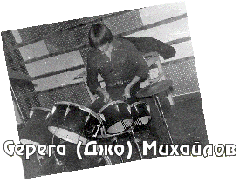
The album turned out. Even though it pathologically lacks high frequencies and has a few blunders, it turned out quite professionally. To this day, I consider it one of the best albums. For the song "From Time", which we once composed long ago together with Joe - Sergei Mikhailov, some Vitalik from Kiev made a video that, according to him, was continuously shown on Kiev television in 94-95. For the song "Morning", a remix was made in 1997 with the vocals of a beginning famous singer Yulka, with which she performed in some nightclub, and everyone seemed satisfied.
Computerization and Gornostaev
The first 286 computers were brought to our office. And along with them, ScreamTracker by Sami Tamilehto fell into my hands. I think it was version 1.something. Or, at best, 2.0. At first, it was completely unclear what to do with it. The couple of STM modules that came with Scream, played through the PC speaker, certainly made an impression. I remember we even tried to attach speaker wires from a player to the speaker outputs, just to somehow improve the sound of the beeper. But it didn't reach a level suitable for recording.
The real breakthrough was the appearance of Covox. I simply did not expect the kind of sound that "poured out" of the 286 computer with a little device made of 10 resistors plugged into the printer port. It was better than anything achieved so far. And it was achieved with much less effort! There was one problem. ScreamTracker was ShareWare and could not save the written modules.
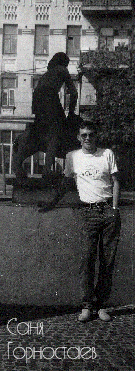
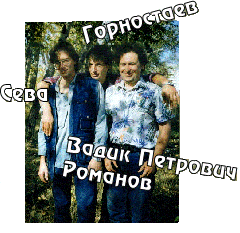
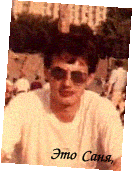
Around the same time, on a trolleybus, I ran into Sanya Gornostaev. Moreover, on the trolleybus he was there as a driver's apprentice. We had studied together at school, then he suddenly disappeared somewhere. As it turned out later, he was trying to get a higher education in the Baltics and Petersburg, which didn't really work out for him. A few days later, he brought me a pile of his poems, reading which I realized that I was not destined to be a poet.
The album "Songs!" was recorded in three days. Before that, Sanya and I spent several evenings in my kitchen, discussing how everything should sound. Then, in one day (!), all the backing tracks were made. I would have been glad to work on the arrangements longer, but the unregistered ScreamTracker did not allow saving what was written, and I didn't have a computer at home, so I couldn't leave it on overnight. The vocal overdubbing was done at Vadik Romanov's place in the usual manner. My old mixer, "NOTA", "SNEZHET", microphones were taken out. The whole lineup that participated in "E.K." gathered to shout. Vadik Romanov connected drive to the guitar, which left its mark on two songs, the first and "Moscow sentry". The song about the French liaison generally became a widely known hit among the narrow circle of "LETIT" fans.
Generally, each of the songs in the original version had its own title. Apparently, the overwhelming feeling of our own informality prompted us to treat them that way. Although, Sanya Gornostaev claims that it was my voluntaristic decision to simply renumber the album's songs. Well, it seems to me that they, the songs, didn't suffer much from that.
Yeltsin, Poland, and Others
In 1992, just after the album "Songs" was finished and the coup in the country successfully ended, Sanya Gornostaev brought another whole pile of poems. By that time, Vadik Romanov and I had managed to download a recording version of ScreamTracker from somewhere in Chisinau. In addition, COVOX had turned from a hastily soldered bunch of resistors into a decent-looking device on a board, with a chip and even a volume control.
The album "Left Hand Rule" was recorded, so to speak, in one breath. The fact that I could save what I wrote, listen and edit with a fresh head without rushing, allowed me to avoid any nervousness. At first I tried to make stereo sound by successive overdubbing, recording first one channel, then the other, but soon gave up on this idea, because either the computer's frequency drifted, or the tape recorder's speed did. So we recorded the "Rule" in mono. Except that the voice was somehow spread across the panorama.
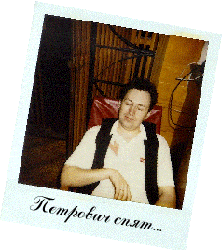
The post-coup euphoria made itself felt. Official statements of the GKChP (State Committee on the State of Emergency) came into play, recorded once by Petrovich (Vadik Romanov) at work while I, maddened by the horror of the moment, rushed around two radio receivers trying to listen to the underground broadcast of Sverdlovsk Radio. Some of Gornostaev's pieces turned out to be very much on point. In addition, new opportunities pushed for new experiments. That's how the song "Flags" appeared, 11 minutes long, in which, as it seemed to me, I squeezed out everything possible from the 4 available tracks of ScreamTracker. Well, and "Autumn Optimistic" still seems to me an unsurpassed example of Gornostaev's art. As does Gornostaev himself, as far as I know.
The album turned out, despite some vocal shortcomings. At least, that's how it seems to me. And, for example, the song about the Foolish Moon ("23:15 mix II") was probably played for about six months as a screensaver before pirate video screenings on local television. One day my wife Sveta even called the editorial office to ask if they wanted to pay me for it. It turned out they didn't.
Tibetan Marches
All the songs of the new album lined up into a completely transparent concept, excuse the expression. A kind of everyday life from dawn to dusk. And the name appeared by itself - "Night Shift". And yet, despite the concept, there is a bunch of all sorts of things here. There's malicious mockery in "Good Morning" and "Good Night", and frank everydayness in "Everydayness" (":seven o'clock, I'm tired as a last bitch:" - that's aphorisms), and the embittered-optimistic "March of the Tibetan Monks". In general, I consider this one of the best "LETIT" albums.
By that time, I had acquired a certain SpeechThing from Alex Tihan. A completely wonderful stereo COVOX that plugged into the computer slot, allowing not only to get rid of wires and power supplies, but also to get wonderful stereo sound. In addition, another breakthrough occurred instrumentally. Andrey Zabolotny from Chisinau wrote a program called SoundWave - a perfect 4-channel tracker with an open driver architecture, an advanced interface, and a built-in stereo panning command (I even tried to buy this program legally, sent two thousand rubles in an envelope to Chisinau, which were never received by the person they were sent to). Bobka Malyanov wrote a driver for SoundWave that allowed mixing a fragment of a 4-channel pattern into one sample, which, generally speaking, removed all limitations on the number of mixable channels. For example, in the song about the "Tibetan Monks", 16 or 18 parts are mixed simultaneously. An analog processor brought from Seva Zhakov, who lived next door, finally allowed me to create something acceptable from my voice. In general, there is nothing in this album that doesn't suit me, strange as it may sound. Well, except for the overall sound quality. But that was the maximum we could achieve in our conditions at that time.
Sound
of Smells
The album "Smells and Sounds", apart from its title (consisting of eight lines), now seems somewhat crumpled and pop-oriented. I tried to achieve perfect sound, which clearly harmed the "drive". In addition, I for some reason undertook to "comb" Gornostaev's poems, which also went the same way. I completely reworked some songs, which I still regret.
And yet, some things sounded good. For instance, I still really like the unexpectedly created 7/8 theme of "Smells and Sounds" itself. "Vegetarian Song" would have been a hit, if I hadn't made such a pop arrangement for it. In "The Last War", another interpretation of the smells and sounds theme sounds, and everything would be fine if the bass guitar had been tuned more carefully. Well, and so on.
Flights to the South
I don't remember well what I did for a whole year. I started recording "Ronalds on a Branch" only in 1996. Gornostaev had somehow disappeared from sight by then. Only a few of his songs made it into the concert, filtered by me from a heap of old papers, plus a number of "little ones" he once quoted while not very sober. During that year, several important events occurred. FastTracker, a 32-track tracker, appeared. I got a 16-bit sound card and learned to extract decent sound from my modules. True, having a 386SX machine with a 200MB hard drive at the time, I had to do it through... some problems. I took Cubic Player and converted my XMs to WAVs, and only then had the opportunity to play them with real sound under MS Windows. It sounded great. It's just that the voice didn't turn out very well. An irresistible desire to cram voice into XM as well prompted me to sample it at 8 kHz. With all the ensuing consequences.
Musically, there is nothing new in this album. I just made music and enjoyed it. I made a remake of the old song of the ensemble "Expedition" with the same name "Expedition", in which I managed to have my wife Sveta sing the chorus. I finished a composition "XII" started two years earlier, the themes of which were actually invented back in the early 80s, when Joe - Sergei Mikhailov - and I were composing a never-finished "Concerto for Moon with Orchestra". A screensaver once invented by me and not accepted by the editors of the local radio station "Radio-Z" also found its place under the same name, mixing with the echoes of the then raging war in Chechnya. And the song "Flight to the South", put together in one breath, unexpectedly became almost the album's hit.
This album almost came out in a CD edition. "Almost" means that the sponsors' enthusiasm lasted only until the meeting with "VK" (Viktor Kotrachev) - the Most Professional Sound Engineer in Chelyabinsk, who tore the quality of my sound to shreds. Most likely he was right. Also, I sold the copyrights to some themes of this album to Vadim Madgazin (Moscow) for use in his game programs. So no one else can use the music from this album in games.
Patriot's Lament
I recorded the album "PENICILLIN" a few months ago, so it's hard for me to say anything meaningful about it. Last year, Sanya Gornostaev, teaming up with Vadik Romanov, decided to oppose me and independently record an acoustic, or rather, "live" album. I never got that album, and Sanya's poems, prepared for this album, Vadik and I had to search for all over his apartment. Having found a sufficiently thick pile of them (poems), I thought I could do something with them. So I made this very "PENICILLIN". Dedicating it to the memory of Emad "Dodi" Al Fayed was Sanya Gornostaev's idea.
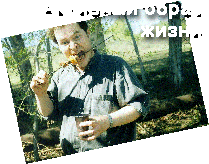
The album turned out aggressive. Generally speaking, that's what I wanted. There are no particularly outstanding compositions. Everything is approximately at the same level. Although many listeners highlight the blues "Chizhovka", which, in fact, Sanya wanted to present as a parody of our folk singer Chigrakov, but it ended up not looking like a parody at all. In some companies, there is still debate about who (or what) is sung about in the song "Yea!". Sanya Gornostaev, as I understand it, is not sure himself. Maybe this song is about our State Duma?.. Songs like "Reservation" and "1984" give the album a kind of folk-patriotic hue, into which, it seems to me, the pessimistic composition to my lyrics "Oxygen" does not quite fit. Although, who knows. The song about "Active Lifestyle" turned out to be very appropriate. I came up with it in about half an hour, along with the arrangement and lyrics (if, of course, it can be called lyrics). This phrase had been circling in my head for several years. Probably, these are echoes of "Vova Siny and His Blue Brothers". Or maybe it just seems that way to me. The poorly translatable German verse for this song was read by my son Vadik Kuznetsov. The compositions "Look Down" and "Emergence" were written by me a year ago specifically for Vadim Madgazin's games. And finally, "Patriot's Lament" - also a kind of Gornostaev patriotism, ending the album if not on an optimistic, then certainly on a life-affirming note.
This album was the first in the history of "LETIT" to be released on compact disc. Naturally, a very limited edition, "cut" independently, with a cover printed on a laser printer, but nevertheless released. The album went to Hartford (Boston area of the New York region), where Seva Zhakov now lives with his family. "Chizhovka" was apparently played for some time on the radio in Rostov-on-Don. Recently, Sanya Gornostaev sent a compact disc to Kiev, to his friend Vitalik, who works at Kiev television and once made a video for one of the songs of "LETIT". In general, promoting continues to this day.
And what next?
I'm itching to write: "Looking back at the path traveled..."...
I'm not looking back at all. Youthful dreams and ambitions are long gone. I haven't wanted to break through anywhere for a long time, and often I don't even fully realize the meaning of these activities of mine. It's just that it "presses" sometimes... And it's gratifying that I'm still capable of something, if my organism at least sometimes demands at least some self-expression. I understand perfectly well that I haven't done anything new. I just do what I like. More and more often I come to the conclusion that you need to try to do what you want here and now. And thinking about meaning and purpose is from the evil one. Sanya Gornostaev has recently been obsessed with the idea of releasing remixes of old songs. I resist as best I can. It seems to me that this would mean drawing some kind of line. Although it's not entirely clear under what.
Dima
G. Kuznetsov, a.k.a. Rick Murray
Chelyabinsk. Middle zone of Russia.
:Hot August evening, 1998.
|